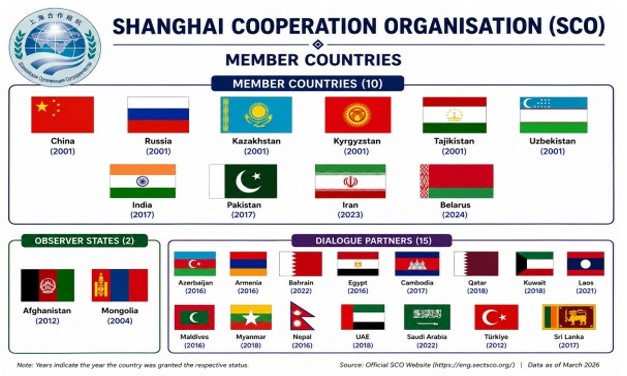
The Shanghai Cooperation Organization (SCO) is a prominent regional multilateral organization that plays a crucial role in fostering cooperation in areas such as political affairs, peace, security, and sustainable development, particularly in the Asian region.
Formation and Background:
The SCO was founded in 2001 and has since evolved into a key platform for collaboration among member states, which include China, India, Kazakhstan, Kyrgyzstan, Russia, Tajikistan, and Uzbekistan. The organization initially emerged from the Shanghai Five mechanism formed in the 1990s, focusing on issues related to security, particularly border security and counter-terrorism.
Objective
The key objectives of the SCO are to:
- Strengthen mutual trust, friendship and good-neighbourly relations among member states.
- Maintain regional peace, security and stability through collective cooperation.
- Combat terrorism, separatism and extremism, along with other transnational security threats.
- Promote cooperation in trade, economy, investment, energy and connectivity.
- Enhance collaboration in science, technology, education, culture, tourism and environmental protection.
- Improve transport and communication linkages among member countries.
- Coordinate efforts against organised crime and drug trafficking, especially where such activities finance terrorism.
- Promote multilateralism and greater coordination on regional and international issues.
- Work towards a more democratic, just and rational international political and economic order.
2026 SCO Summit
- The 26th Shanghai Cooperation Organisation (SCO) Council of Heads of State summit took place from August 31 to September 1, 2026, in Bishkek, Kyrgyzstan.
- It marked the 25th anniversary of the founding of the SCO, with the theme “25 Years of the SCO: Together for Sustainable Peace, Development and Prosperity”.
- Leaders signed the joint Bishkek Declaration, addressing regional security, economic cooperation, and global issues
SCO Bishkek Declaration 2026
|
Theme |
Takeaways |
|
1. Counter-Terrorism and Security |
|
|
2. Sovereignty, Non-Interference and State Authority |
|
|
3. Iran and West Asia Conflict |
|
|
4. SCO’s Strategic Character |
|
|
5. Global Geopolitical and Economic Challenges |
|
|
6. Human Rights and International Order |
|
|
7. India’s Initiatives within the SCO |
|
|
8. Future Presidency and India’s Diplomatic Challenge |
|
India’s Role / Participation in SCO Summit 2026
- Security & Counter-Terrorism: India stressed zero tolerance towards terrorism, separatism and extremism, rejection of double standards, and action against terror financing, recruitment, radicalisation and safe havens.
- Security–Connectivity–Opportunity: PM Modi identified these as the three pillars of India’s SCO approach, linking regional stability with trade, growth and development.
- Connectivity with Sovereignty: India supported better roads, railways, air corridors, customs, digital documentation and logistics, while insisting on respect for sovereignty and territorial integrity.
- Peace & Global South: India advocated dialogue and diplomacy for resolving conflicts and highlighted their impact on the Global South through energy insecurity, supply-chain disruption and trade instability.
- Youth, Innovation & Growth: India promoted cooperation in startups, youth, innovation, entrepreneurship and economic opportunities across SCO countries.
- Bilateral Engagement: PM Modi used the summit for meetings with leaders of Russia, Iran, Kyrgyzstan and Armenia, strengthening bilateral and regional cooperation.
- Overall: India projected itself as a security-focused, sovereignty-conscious and development-oriented SCO member committed to peace, connectivity and regional cooperation.
Significance of SCO Summit 2026, Bishkek
- 25 Years of SCO: The summit marks the organisation’s 25th anniversary, reflecting its evolution from a security-focused grouping into a broader platform for Eurasian cooperation.
- Platform for Eurasian Coordination: It brings major Eurasian powers together to discuss regional security, trade, connectivity, transport corridors and emerging geopolitical challenges.
- Central Asia at the Core: Kyrgyzstan’s hosting highlights the growing strategic importance of Central Asia, especially for regional transport, railway connectivity and access to wider Eurasian markets.
- Stronger Security Cooperation: The summit reinforces collective action against terrorism, separatism, extremism, organised crime and cyber threats through deeper institutional coordination.
- Energy and Sustainable Development: Cooperation on energy security, green development, climate change, water resources and environmental protection adds a long-term development dimension to the SCO agenda.
- India’s Strategic Relevance: India’s emphasis on Security, Connectivity and Opportunity, along with respect for sovereignty and territorial integrity, gives the summit a more balanced development and security orientation.
- Future Direction of SCO: The Bishkek summit signals a shift toward practical implementation, stronger institutional cooperation and consensus-based regionalism while accommodating diverse national interests.


.svg.png)


