
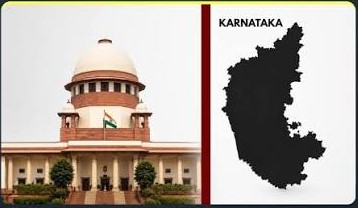
The publication of Karnataka’s final electoral roll after the Special Intensive Revision (SIR) has triggered one of the most consequential debates over electoral-roll management in recent years.
At almost the same time, the Supreme Court agreed to closely examine challenges concerning the Election Commission of India’s conduct of the wider SIR exercise, including demands for preservation of internal records and allegations concerning the procedure surrounding Form 6. The Court has not yet ruled that these allegations are correct; they remain matters to be adjudicated.
The two developments raise a fundamental democratic question: How should India clean and update its electoral rolls without risking the exclusion of eligible citizens?
What exactly happened in Karnataka?
The scale of Karnataka’s revision is striking.
Before the SIR, the State had about 5.54 crore electors. The draft roll fell to roughly 4.46 crore, while the final roll recovered to approximately 4.55 crore after the claims, objections and inclusion process.
Thus, the final list is about 99.32 lakh names smaller than the pre-SIR roll. The final electorate includes approximately 2.25 crore men, 2.29 crore women and 2,841 third-gender electors, while more than 6.83 lakh voters are aged 18–19.
The decline of approximately 17.9% is unusually large. Among States and Union Territories where final rolls had been published under different SIR phases by October 28, Karnataka recorded one of the steepest proportional reductions.
But this number requires careful interpretation.
A net reduction is not the same as 99 lakh proven wrongful deletions
The headline figure should not automatically be read as meaning that nearly one crore eligible citizens were wrongly disenfranchised.
An electoral roll changes for many reasons: electors may have died, permanently shifted residence, been registered more than once, become otherwise ineligible, or failed to establish their continued linkage with a constituency during the revision process.
The Election Commission’s SIR framework itself provides for Booth Level Officers to identify probable reasons such as “Absent/Shifted/Death/Duplicate” where enumeration forms are not returned.
The correct analytical question is therefore not simply “How many names disappeared?”, but “How many eligible electors, if any, were wrongly excluded, and were adequate opportunities available to restore them?”
That distinction is central to assessing the legitimacy of the exercise.
The claims-and-objections process did restore names
The draft electoral roll was not the final word.
During the subsequent claims and objections stage, applications for fresh inclusion were processed and a substantial number of electors were added back to the roll. Available data shows that the final list increased by more than 8 lakh electors compared with the draft stage.
Reports indicate that more than 10 lakh new inclusions were accepted during the claims process, while around 1.88 lakh entries were deleted and nearly 8.97 lakh entries were corrected or modified during this stage.
This is important because electoral rolls are not intended to become permanently closed after an SIR. Eligible citizens can continue to seek inclusion through the prescribed statutory mechanism, subject to the applicable electoral law and cut-off rules.
However, the unusually large difference between the pre-SIR and final numbers also makes transparency over the reasons for exclusion especially important.
Why does India conduct Special Intensive Revisions?
The objective of an electoral roll is straightforward but constitutionally important: every eligible citizen should be included and every ineligible entry should be removed.
The Election Commission formally states the objective of SIR in almost exactly these terms—“No eligible citizen is left out while no ineligible person is included in the Electoral Roll.”
Ordinary electoral-roll revisions take place periodically. An intensive revision goes further by undertaking a more comprehensive verification exercise rather than merely updating an existing database.
In Karnataka’s case, the ECI’s 2026 schedule involved house-to-house visits by Booth Level Officers, publication of a draft roll, a claims-and-objections period, hearings and verification, followed by publication of the final electoral roll.
Such an exercise can improve roll quality by identifying:
- deceased electors;
- permanently shifted voters;
- duplicate registrations;
- entries of persons who are no longer ordinarily resident in the constituency;
- missing eligible citizens;
- errors in names, addresses and demographic details.
The challenge lies not in the objective of roll purification but in how that objective is implemented.
What is the legal basis of SIR?
The Election Commission has invoked Article 324 of the Constitution, Section 21 of the Representation of the People Act, 1950, other applicable provisions of the Act, and the Registration of Electors Rules, 1960 for conducting SIR.
Section 21 of the Representation of the People Act, 1950 specifically provides for preparation and revision of electoral rolls. Importantly, Section 21(3) authorises the Election Commission to direct a special revision of an electoral roll at any time, for reasons to be recorded.
The wider legal framework also establishes basic eligibility principles.
Under Section 19, a person who is at least 18 years old on the qualifying date and is ordinarily resident in a constituency is entitled, subject to other statutory conditions, to be registered there. Sections 17 and 18 prevent registration in more than one constituency or more than once in the same constituency.
Section 22 permits correction, transposition or deletion of entries on grounds including death, cessation of ordinary residence or other ineligibility, subject to verification. The law therefore recognises both sides of electoral-roll integrity: preventing wrongful inclusion and preventing wrongful exclusion.
Why has the Supreme Court stepped in?
The controversy extends beyond Karnataka.
Multiple petitioners have challenged aspects of the SIR process before the Supreme Court. During the latest proceedings, a Bench headed by Chief Justice of India Surya Kant indicated that it would examine the issues raised before it and listed the matter for further hearing in November.
One major demand concerns preservation of the Election Commission’s records, file notings and internal communications relating to SIR decisions.
The petitioners argue that these documents may be necessary to understand how significant decisions were taken and whether the statutory and institutional process was properly followed.
The ECI, on the other hand, has maintained that its decisions were lawful and has disputed allegations that its internal decision-making process was improper.
At this stage, therefore, it is essential to distinguish between allegations placed before the Court and judicial findings. The Supreme Court has agreed to examine the claims; it has not yet validated them.
Another major dispute concerns Form 6, the statutory application used by eligible persons seeking inclusion in an electoral roll.
Petitioners have alleged that the ECI effectively altered or supplemented the Form 6 process by requiring an additional declaration and have questioned whether this was legally permissible.
The ECI’s position is that the additional declaration is separate from the statutory Form 6, rather than an unauthorised modification of Form 6 itself.
Official ECI directions do show that electors unable to submit enumeration forms within the prescribed period could apply through Form 6 along with a prescribed Declaration Form during the claims-and-objections stage.
The legal issue before the Court is therefore more nuanced than whether Form 6 physically changed. The larger question is whether additional procedural requirements imposed alongside the statutory form are consistent with the Representation of the People Act and the Registration of Electors Rules, and whether they place an unreasonable burden on otherwise eligible voters.
Inclusion versus purification: the central constitutional tension
Every credible electoral system must pursue two goals simultaneously.
First, an electoral roll should be clean. Duplicate names, deceased persons, permanently shifted residents and other ineligible entries undermine accuracy and public confidence.
Second, an electoral roll must be inclusive. An eligible citizen should not lose the ability to vote merely because of an administrative error, an excessively burdensome documentation requirement or failure of communication by electoral authorities.
These objectives are complementary in theory but can conflict during mass verification exercises.
An excessively permissive system can allow inaccurate entries to remain. An excessively restrictive system can exclude legitimate voters.
The constitutional challenge is therefore to build a process with a sufficiently high standard of verification without converting the burden of electoral-roll cleaning into an unreasonable burden on individual citizens.
Why procedural safeguards matter
Unlike many administrative databases, an electoral roll determines who can participate directly in choosing representatives.
A wrong entry in an ordinary government database may cause inconvenience. A wrongful exclusion from an electoral roll can prevent a citizen from exercising the franchise in an election.
This makes notice, transparency, opportunity to respond and accessible remedies particularly important.
A robust SIR system should therefore ensure that:
- electors are clearly informed when their names are proposed for exclusion;
- reasons for non-inclusion or deletion are identifiable;
- affected voters receive a meaningful opportunity to establish eligibility;
- claims and objections are decided within reasonable timelines;
- decisions can be appealed or reviewed;
- voter lists and exclusion categories are published in a manner that allows public scrutiny;
- technology assists verification rather than becoming an additional barrier.
The ECI’s directions already contain mechanisms such as house-to-house BLO visits, publication of lists and claims-and-objections procedures.
The dispute is over whether these safeguards were adequate and effectively implemented at the scale required.
The Karnataka numbers raise two important questions
1. Why was the pre-SIR roll so much larger?
If most of the 99.32 lakh net reduction represents deceased, shifted, duplicate or otherwise ineligible entries, it would raise serious questions about why such a large volume of obsolete entries accumulated in the first place.
2. How many eligible electors were excluded but later restored?
The difference between the draft and final rolls demonstrates that the correction mechanism mattered.
Transparency is the best answer to political controversy
Electoral-roll revisions inevitably become politically sensitive because additions and the best institutional response is therefore maximum verifiable transparency.
Aggregate figures should ideally be accompanied by granular information showing categories such as dead, shifted, duplicate, untraceable, ineligible, refused, restored after claim, newly enrolled and pending.
The Supreme Court’s role
The Supreme Court does not need to choose between the abstract objectives of electoral-roll cleaning and voter inclusion. Both are legitimate.
Its more important task is likely to be defining the constitutional and statutory safeguards within which an intensive revision may operate.
Questions that may require clarification include:
- the extent of the ECI’s power under Article 324 and Section 21;
- the legal status of additional declarations used during SIR;
- the burden of proof placed on existing electors;
- the level of notice required before exclusion;
- preservation and disclosure of decision-making records;
- remedies available to wrongly excluded voters;
- and the degree of procedural uniformity required across States.
The eventual judicial guidance could therefore influence not merely the current dispute but the design of future nationwide electoral-roll revisions.
What should be done going forward?
India needs accurate electoral rolls, but accuracy must be achieved through an inclusion-first, evidence-based and transparent verification process.
The ECI should publish detailed anonymised statistics explaining the reasons behind large-scale changes in electoral rolls and the number of voters restored through claims.
Electors should receive simple digital and offline mechanisms to check their status, understand the reason for exclusion and seek correction.
Booth Level Officers should be adequately trained and given sufficient time for physical verification, particularly in areas with high migration.
Special safeguards may also be necessary for migrant workers, students, tenants, elderly citizens, persons with disabilities and economically vulnerable populations, who may be more difficult to locate during door-to-door verification.
Finally, judicial scrutiny should clarify the rules before future large-scale revisions so that both electoral authorities and citizens know exactly what documentation, notice and procedural protections are legally required.
Conclusion
Karnataka’s SIR has produced a dramatic statistical result: the electoral roll has fallen from roughly 5.54 crore to 4.55 crore electors, a net decline of about 99.32 lakh.
But the number alone cannot tell us whether the exercise was a successful clean-up of an outdated roll or whether eligible voters were improperly excluded. That determination requires category-wise data, scrutiny of the claims process and evidence about the treatment of individual electors.
At the same time, the Supreme Court’s decision to examine challenges surrounding the wider SIR exercise places the legal architecture of electoral-roll revision under significant scrutiny.
The fundamental principle should remain simple: an electoral roll must exclude those who are legally ineligible without making eligibility unnecessarily difficult for genuine citizens to establish.
In a democracy, the integrity of an election begins even before a vote is cast. It begins with deciding whose name appears on the electoral roll.


