
Cold War
Cold War
The end of the Second World War marked a major turning point in world history. The Allied Powers, led by the USA, USSR, Britain and France, defeated the Axis Powers led by Germany, Italy and Japan. Japan’s surrender after the atomic bombings of Hiroshima and Nagasaki brought the war to an end in 1945.
However, the end of World War II did not bring lasting peace. Instead, it marked the beginning of a new phase in contemporary world history—the Cold War. After 1945, the United States of America and the Soviet Union emerged as the two major superpowers. Their rivalry shaped global politics for nearly the next five decades.
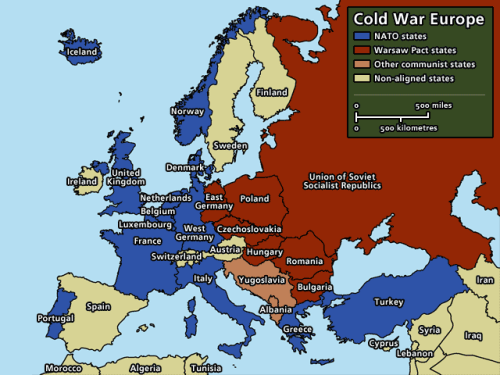
The Cold War was not a direct military war between the USA and USSR. Rather, it was a period of political tension, ideological rivalry, military competition, arms race, proxy wars and diplomatic conflict. The USA represented the capitalist and democratic bloc, while the USSR represented the communist and socialist bloc.
The pre-World War II world was largely multipolar, with several powerful nations influencing international politics. After 1945, this multipolarity gave way to bipolarity, where the world was divided into two rival camps: the US-led Western bloc and the Soviet-led Eastern bloc.
Old ideological differences, which had remained suppressed during the war against the Axis Powers, resurfaced after 1945. The USA feared the spread of communism, while the USSR feared Western capitalist encirclement. This mutual suspicion resulted in the formation of military alliances, nuclear competition and conflicts in different parts of the world.
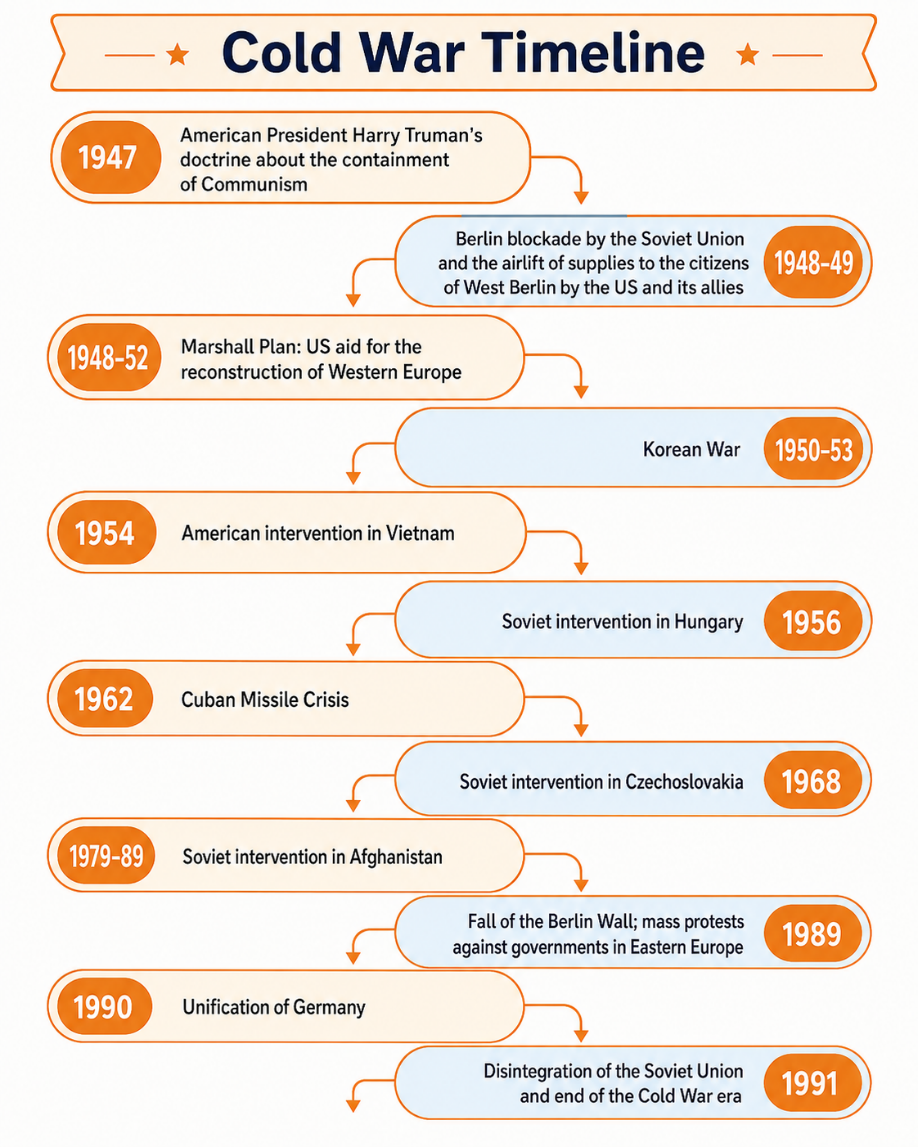
Major events of the Cold War included the Truman Doctrine, Marshall Plan, Berlin Blockade, Korean War, Cuban Missile Crisis, Vietnam War, Soviet intervention in Afghanistan and the arms race. The Cold War finally ended with the fall of the Berlin Wall in 1989, the unification of Germany in 1990, and the disintegration of the Soviet Union in 1991.
Thus, the Cold War was a defining feature of the post-1945 world order. It transformed international relations from multipolarity to bipolarity and shaped global politics, military strategy, economy and diplomacy throughout the second half of the 20th century.
Extent of the Cold War
- Eastern Bloc - The Eastern Bloc consisted mainly of the countries of Eastern Europe that came under the influence of the Soviet Union after World War II. These countries followed communist ideology and remained aligned with the USSR.
- Western Bloc- The Western Bloc included the countries of Western Europe and other allies of the United States. These countries supported liberal democracy, capitalism and market-oriented economic systems.
Cold War: Meaning and Nature
The Cold War refers to the hostile relationship between the United States of America and the Soviet Union after the Second World War, which continued until the disintegration of the USSR in 1991.
It is called a “Cold” War because the two superpowers did not fight a direct military war against each other. Instead, their rivalry was expressed through ideological conflict, arms race, military alliances, economic competition, propaganda and proxy wars in different parts of the world.
Nature of the Cold War
1. Bipolar World Order- After World War II, Britain and other European powers declined, while the USA and USSR emerged as two superpowers. Most countries aligned themselves with either of these two blocs, creating a bipolar international order.
2. Ideological Conflict- The Cold War was mainly an ideological struggle. The USA supported capitalism, liberal democracy and free-market economy, while the USSR promoted communism, socialism and state-controlled economy.
3. No Direct War between Superpowers- The Cold War remained largely non-direct and non-conventional. The USA and USSR avoided direct military confrontation, but they supported rival sides in conflicts such as the Korean War, Vietnam War and Arab-Israel conflicts.
4. Nuclear Deterrence - Both superpowers possessed nuclear weapons, which created fear of Mutually Assured Destruction (MAD). This nuclear balance prevented direct war, as any conflict could have destroyed both sides.
5. Brinkmanship - Brinkmanship refers to pushing a crisis close to the point of war but stopping short of actual conflict. The Cuban Missile Crisis of 1962 was the best example, where the USA and USSR came very close to nuclear war.
6. Arms Race - Both superpowers continuously expanded their stock of nuclear and conventional weapons to protect their interests and maintain strategic superiority.
7. Formation of Alliances - The USA and USSR built military and political alliances to expand their influence. The USA supported alliances such as SEATO and CENTO, while the USSR strengthened its influence in Eastern Europe.
8. Military Blocs - The USA-led Western bloc formed NATO in 1949. In response, the Soviet Union formed the Warsaw Pact in 1955 with its satellite states in Central and Eastern Europe.
9. Economic Competition - The USA provided the Marshall Plan for the reconstruction of Western Europe after World War II. In response, the Soviet Union supported the Council for Mutual Economic Assistance (CMEA/COMECON) to strengthen economic cooperation among socialist countries.
Marshall Plan
- The Marshall Plan, officially known as the European Recovery Program, was an American initiative launched to rebuild Europe after the Second World War. Between 1948 and 1951, the United States provided more than $13 billion in financial assistance for Europe’s economic recovery.
- The plan was announced by U.S. Secretary of State George C. Marshall in his Harvard University speech on 5 June 1947. Its main objective was to restore economic stability, rebuild war-damaged economies and revive confidence among European people in their future.
- For the United States, the Marshall Plan was seen as generous economic aid to Europe. However, the Soviet Union viewed it as an attempt by the USA to interfere in the internal affairs of European countries and expand American influence. As a result, the USSR rejected the plan and also prevented countries like Poland and Czechoslovakia from participating.
- The Marshall Plan also encouraged European economic cooperation and integration. It helped create conditions favourable for American investment and strengthened the capitalist bloc in Western Europe during the Cold War.
Causes of the Cold War
The Cold War was mainly caused by the ideological conflict between capitalism and communism. However, its immediate causes can be understood in the context of World War II.
- Ideological Rivalry - The USA supported capitalism, liberal democracy and free markets, while the USSR promoted communism, socialism and state control. This ideological clash created deep distrust between the two powers.
- Western Appeasement of Hitler - Before World War II, the USA and Britain followed a policy of appeasement towards Hitler. The USSR believed that Western powers encouraged Germany to expand eastward to weaken communism.
- Delay in Opening Second Front - During World War II, the Soviet Union demanded that the Allies open a second front against Germany in Western Europe. The delay created suspicion that the West wanted Germany and the USSR to weaken each other.
- Secret Manhattan Project - The USA secretly developed the atomic bomb under the Manhattan Project without fully informing the USSR. This increased Soviet distrust of American intentions.
- Disputes in Wartime Conferences - Differences emerged during wartime conferences over the future of Germany, Poland and Eastern Europe after the war. These disagreements later became major sources of Cold War tension.
- Atomic Bombing of Japan - The US bombing of Hiroshima and Nagasaki in 1945 demonstrated American nuclear superiority. This created insecurity in the USSR and pushed both powers towards an arms race.
Factors Responsible for the Cold War
|
Factor |
Main Argument |
Explanation |
|
Stalin Responsible |
Stalin wanted to spread communism and expand Soviet influence. |
According to this view, Stalin aimed to weaken capitalism and dominate Eastern Europe. This created fear among Western countries and led to the formation of NATO in 1949. US actions, such as support to South Korea in the Korean War, were seen as defensive steps to protect the “Free World” from communism. |
|
Truman Doctrine Responsible |
US policy of containment provoked Soviet hostility. |
Some scholars argue that the Truman Doctrine and aggressive US foreign policy were responsible for the Cold War. US interventions in Vietnam and support to anti-communist regimes created insecurity in the USSR. According to this view, the Cold War could have been avoided if the West had accepted Eastern Europe as the Soviet sphere of influence. |
|
Both USA and USSR Responsible |
Mutual distrust and power politics caused the Cold War. |
This balanced view argues that both superpowers shared responsibility. The Marshall Plan increased US influence in Europe, while Stalin used opportunities to expand Soviet control. Lack of trust made each side interpret the other’s actions as aggressive, leading to rivalry, arms race and bloc politics. |
According to this view, Stalin aimed to weaken capitalism and dominate Eastern Europe. This created fear among Western countries and led to the formation of NATO in 1949. US actions, such as support to South Korea in the Korean War, were seen as defensive steps to protect the “Free World” from communism.
Evolution of the Cold War
Winston Churchill’s Fulton Speech, 1946, in which he used the term “Iron Curtain”, is often considered the beginning of the Cold War. The Iron Curtain symbolised the division between the Western capitalist bloc and the Eastern communist bloc.
Phase I: 1946–1962
- Cold War in Europe- In 1947, the USA introduced the Marshall Plan of about $13 billion for post-war reconstruction of Europe and to attract European countries towards capitalism. In response, the USSR introduced the Molotov Plan, Cominform and later CMEA/COMECON to strengthen socialist economies of Eastern Europe.
- In 1948, the USSR imposed the Berlin Blockade by cutting rail, road and canal routes to West Berlin. The USA and its allies responded through the Berlin Airlift, supplying essentials by air and making the blockade ineffective.
- In 1949, the USSR tested its first nuclear bomb, ending the US nuclear monopoly and beginning a serious nuclear arms race. The same year, the USA and its allies formed NATO, while the Soviet Union later responded through the Warsaw Pact in 1955.
- In 1953, both superpowers moved towards hydrogen bomb testing. Stalin’s death in the same year created a temporary thaw in Cold War tensions. However, in 1961, the construction of the Berlin Wall became a visible symbol of Cold War division.
- Cold War in Asia- The communist victory in China in 1949 strengthened the Soviet bloc in Asia. The Korean War, 1950–53, divided Korea into North Korea, supported by China and the USSR, and South Korea, supported by the USA, along the 38th parallel.
- The Vietnam War, 1955–75, became another major Cold War conflict, where communist forces were supported by the USSR while the USA backed anti-communist forces. This war weakened American influence in Asia.
- The Arab-Israel conflict, 1948, also reflected Cold War alignments. The USA supported Israel, while the USSR sympathised with Arab states. Later, the US-sponsored Baghdad Pact led to the formation of CENTO, involving the USA, UK, Iran, Iraq and Pakistan.
- Cuban Missile Crisis, 1962- The Cuban Missile Crisis was the most dangerous event of the first phase of the Cold War. The USSR installed missiles in Cuba, close to US territory. The USA reacted strongly and warned of military action if the missiles were not removed.
- Since any nuclear conflict could have led to Mutually Assured Destruction (MAD), the USSR finally withdrew the missiles. This crisis brought the world closest to a possible Third World War but also showed the importance of nuclear restraint.
Phase II of the Cold War: Détente, 1962–1979
- The second phase of the Cold War is known as the period of détente, meaning relaxation of tensions between the USA and the USSR. The immediate reason was the fear created by the Cuban Missile Crisis, which had brought the world close to nuclear war.
- Both superpowers also faced internal and external pressures. The USSR was dealing with economic problems and leadership challenges, while the USA was facing competition from Western Europe and Japan, along with the burden of global commitments.
Important Developments
- Partial Test Ban Treaty, 1963/1964: It banned nuclear tests in the atmosphere, outer space and underwater, but allowed underground testing.
- Non-Proliferation Treaty, 1968: It aimed to prevent the spread of nuclear weapons and promote peaceful use of nuclear energy.
- US Recognition of China, 1971: The USA moved towards recognising the People’s Republic of China, showing a shift in Cold War diplomacy.
- Helsinki Accords, 1975: Both Eastern and Western blocs agreed to maintain the post-war status quo in Europe. The West recognised communist control in Eastern Europe, while the USSR accepted the importance of human rights.
Phase III: New Cold War, 1979–1989
- The period of détente ended after the Soviet invasion of Afghanistan in 1979. The USSR intervened to support the communist government in Afghanistan, while the USA, Western countries and Pakistan supported the Mujahideen against Soviet influence.
- This phase again witnessed intense rivalry between the two superpowers. Both the USA and USSR expanded their military strength and increased the stockpiling of conventional arms and nuclear weapons.
- Under President Ronald Reagan, the USA adopted a more aggressive anti-Soviet policy. He launched the Strategic Defense Initiative (SDI), popularly known as Star Wars, which aimed to develop space-based missile defence systems.
- Later, Mikhail Gorbachev tried to improve relations with the USA through reforms and dialogue. However, he could not revive the weakening Soviet economy. Economic crisis, internal political problems and pressure from Eastern Europe eventually led to the disintegration of the USSR in 1991, marking the end of the Cold War.
End of the Cold War
The end of the Cold War was sudden, dramatic and unexpected. A communist system that had survived for more than 70 years collapsed within a short period between 1989 and 1991. In countries where communist regimes survived, such as China, major reforms were introduced to adapt communism to changing global realities.
In 1990, the Charter of Paris for a New Europe formally declared the end of the Cold War. In 1991, the Soviet Union disintegrated, bringing the Cold War era to an end.
Factors Responsible for the End of the Cold War
The collapse of communism and the end of the Cold War were caused by several factors:
- Structural Weakness of Soviet Communism - Soviet-style communism suffered from deep internal weaknesses. Its political and economic systems were rigid, centralised and unable to respond effectively to changing needs.
- Economic Limitations - The centrally planned economy failed to match capitalist economies in terms of prosperity, innovation and production of consumer goods. By the 1980s, economic backwardness created public dissatisfaction and a desire for Western-style living standards.
- Political Limitations - Communist regimes lacked democratic mechanisms such as competitive elections, free press, independent organisations and political accountability. As a result, public grievances could not be expressed peacefully or addressed effectively.
- Gorbachev’s Reforms - Mikhail Gorbachev introduced reforms such as glasnost and perestroika to modernise the Soviet system. However, these reforms weakened central control and encouraged demands for political freedom and autonomy.
- US Pressure and the Second Cold War - The aggressive policies of the USA during the Second Cold War increased pressure on the Soviet Union, especially through military competition and defence spending.
- Globalisation and Western Influence - Economic and cultural globalisation exposed people in communist countries to Western prosperity, consumer culture, civil liberties and democratic values. This increased dissatisfaction with communist rule.
Impact of Gorbachev’s Reforms
The structural weaknesses of communism explain why the Soviet system was vulnerable, but they do not fully explain the sudden and rapid collapse of communist regimes between 1989 and 1991. The immediate trigger was the reform process introduced by Mikhail Gorbachev after 1985. His reforms weakened the old Soviet system and unintentionally accelerated its collapse.
1.Perestroika means economic restructuring. It aimed to reform the Soviet economy by introducing limited market competition, private ownership and decentralisation. Gorbachev wanted to correct the weaknesses of central planning.
However, the reform created instability. It weakened the old planned economy without creating an efficient market economy. As a result, production declined, shortages increased and economic dissatisfaction grew.
2. Glasnost means openness. It allowed greater freedom of expression, public debate and criticism of the government. It removed many restrictions on media and political discussion.
However, glasnost also gave voice to the opponents of Gorbachev. Hard-line communists criticised reforms, while radicals demanded an end to communist rule itself. This weakened the authority of the Communist Party and isolated Gorbachev politically.
3. The Sinatra Doctrine replaced the earlier Brezhnev Doctrine. Under this policy, the Soviet Union allowed Eastern European countries to choose their own political path. It meant that Moscow would no longer use military force to protect communist regimes in Eastern Europe.
As a result, communist governments in Eastern Europe collapsed one after another in 1989–90. The fall of the Berlin Wall became the most powerful symbol of this change.
US Policy and the Second Cold War
- Another reason for the end of the Cold War was the pressure created by US policies under President Ronald Reagan. In the 1980s, the USA launched a renewed military build-up, known as the Second Cold War.
- The most important initiative was the Strategic Defence Initiative (SDI), also called Star Wars, launched in 1983. It aimed to develop space-based missile defence systems.
- This forced the Soviet Union into an expensive arms race. Since the Soviet economy was already weak, it could not sustain such military competition. This increased economic pressure and strengthened the demand for reform.
Economic and Cultural Globalisation
- Economic globalisation widened the gap between the capitalist West and the communist East. Western countries benefited from international trade, investment and technological development, while the Soviet bloc remained isolated and economically stagnant.
- Cultural globalisation also played an important role. Radio, television and other media exposed people in Eastern Europe to Western prosperity, freedom and consumer culture. This increased dissatisfaction with communist rule and encouraged demands for economic and political reforms.
- Gorbachev’s reforms, US military pressure and globalisation together accelerated the end of the Cold War. Perestroika weakened the Soviet economy, glasnost weakened political control, and the Sinatra Doctrine allowed Eastern Europe to break away from Soviet domination. At the same time, the arms race and exposure to Western prosperity made the Soviet system unsustainable.


.svg.png)


