
Fascism and Nazism
Fascism and Nazism
- The unification of Italy in 1870 failed to improve its economic condition. Instead, the situation worsened in the early 20th century due to Italy’s costly involvement in World War I. Economic crisis, unemployment and political instability created widespread dissatisfaction against the government.
- The immediate trigger was Italy’s disappointment at the Paris Peace Conference, where it felt unfairly treated despite being on the winning side. In this atmosphere of frustration, Benito Mussolini rose to power through the organised mass demonstration known as the March on Rome.
- Fascism was not a clearly defined ideology but a set of authoritarian policies and practices. Mussolini’s Fascism differed from other forms seen under Hitler in Germany, Franco in Spain, Salazar in Portugal and Peron in Argentina.
- The term Fascism comes from the Latin word fasces, meaning symbols of authority in Ancient Rome. The German form of Fascism came to be known as Nazism.
Definition of Fascism
Fascism was an authoritarian and ultra-nationalist political system that rejected liberal democracy, socialism and individual freedom. It emphasised absolute loyalty to the State, one-party rule, a powerful leader, militarism, discipline and aggressive nationalism. In Italy, Fascism developed under Benito Mussolini, who presented it as a solution to political instability, economic crisis and national humiliation after World War I.
Mussolini’s Fascist Doctrine
- Stable and Authoritarian Government- Fascists believed that democracy created division, instability and weak decision-making. They argued that only a strong authoritarian government could provide discipline, unity and effective leadership. The State was expected to control major aspects of people’s lives and suppress forces that created social or political division.
- Extreme Nationalism- Fascism promoted intense nationalism and glorified the nation above the individual. It also believed in racial and cultural superiority, arguing that “superior” nations had the right to dominate weaker or “inferior” nations. Mussolini used this idea to revive pride in Italy’s Roman past and to create confidence in Italian power and expansion.
- One-Party State- Fascists rejected democratic competition and multi-party politics. They believed that economic crisis required quick and firm decisions, which only a one-party dictatorship could provide. Mussolini projected himself not merely as a head of government but as Il Duce, meaning “the Leader”, symbolising unity, discipline and absolute authority.
- Economic Self-Sufficiency- Fascism supported autarky, or economic self-sufficiency. It aimed to reduce dependence on foreign trade and strengthen national production. The government directed economic life through state control, planning and intervention, while still allowing private property under state supervision.
- Propaganda and Mass Mobilisation- Fascists used modern propaganda to build public support and glorify the regime. Uniforms, marches, slogans, songs, symbols and public displays were used to present Fascism as dynamic, heroic and superior to traditional political parties. Propaganda helped create loyalty towards the leader and the State.
- Military Strength and Violence- Fascism glorified military power, war and violence. Political opponents, dissenters and critics were suppressed through threats, intimidation and force. Mussolini believed that aggressive foreign policy required a strong army and a disciplined society ready for conflict.
Reasons for Mussolini’s Rise
Several factors helped Mussolini rise to power and establish Fascist dictatorship in Italy.
- Post-War Discontent and National Humiliation- Italy joined World War I expecting territorial gains, but at the Paris Peace Conference, it did not receive all promised territories. Albania was made independent and some territories went to Yugoslavia. This created a feeling of betrayal and humiliation, weakening public faith in the Italian government.
- Political Instability and Economic Crisis- The system of proportional representation produced weak coalition governments with Liberals, Socialists, Catholics, Nationalists and Communists. These governments failed to control unemployment, inflation and post-war economic distress. This made people lose confidence in democracy and created demand for strong leadership.
- Fear of Socialism and Communism- In 1919–1920, Italy witnessed strikes, riots, factory occupations and land seizures by workers and peasants. Factory councils appeared in cities like Turin, resembling Russian Soviets. This created fear among industrialists, landlords, the Church, monarchy and middle class, who began to see Mussolini as a protector of property, religion and law and order.
- Mussolini’s Political Strategy and Social Support- Mussolini shifted from socialism to the extreme right. He dropped his anti-Church, anti-monarchy and anti-business positions and projected himself as a nationalist leader. By gaining support from the monarchy, Church, industrialists, landlords and middle class, he created a broad anti-communist support base. The Lateran Treaty, 1929 further strengthened his legitimacy by securing Church support.
- Violence, Legal Manipulation and Weak Opposition- Mussolini used Blackshirt squads, propaganda and the March on Rome, 1922 to project himself as Italy’s saviour. The opposition remained divided, especially between Socialists and Communists. After coming to power, he used the Acerbo Law, constitutional changes, censorship, corporate state and administrative control to weaken democracy and establish Fascist dictatorship.
Economic and Social Reasons for the Growth of Fascism
1. Poor Economic Conditions
The impact of World War I on Italy’s economy was severe. Industrial production declined, public debt increased and the government had to bear a heavy burden of interest payments. Falling living standards, inflation and widespread unemployment created deep dissatisfaction among the people against the existing government.
2. Fear of Communism
Communist-led strikes, factory occupations, riots and land seizures further weakened the economy and created social disorder. The formation of the Communist Party in 1921 increased fear among industrialists, landlords and the middle class. As Mussolini strongly opposed communism, the business class began to support him as a defender of property, order and economic stability.
3. Social Unrest and Class Conflict
Italy witnessed growing conflict between workers, peasants, landlords and industrialists. Soviet-type workers’ organisations began to emerge, creating panic among conservative groups. Mussolini used this fear to project Fascism as the only force capable of restoring law, discipline and national unity.
4. Racial Policy
Racial policy was not an original reason for Mussolini’s rise to power. In the beginning, he was not anti-Jewish and even criticised Nazi anti-Semitism. However, later, under the influence of Hitler and Italy’s alliance with Germany, Fascism adopted a stronger racial tone.
Mussolini began to claim that Italians belonged to the Aryan race and were superior to Africans and some other nationalities. After moving closer to Germany and signing the Pact of Steel in 1939, he adopted Nazi-style racial ideas. In 1938, the Charter of Race declared Arabs, Africans and Jews as inferior.
Fascism: A Critical Analysis
|
Positive Aspects of Fascism |
Negative Aspects of Fascism |
|
Industrial Growth: Mussolini encouraged industries like iron and steel, textiles, artificial silk and hydropower through state support and subsidies. |
Failure of Self-Sufficiency: Italy failed to become self-sufficient in coal, oil and steel, making it dependent on Nazi Germany. |
|
Agricultural Development: The Battle of Wheat increased wheat production and supported the idea of autarky or self-sufficiency. |
Damage to Exports: Revaluation of the lira made Italian exports costly and less competitive in international markets. |
|
Land Reclamation: Marshlands were drained and brought under cultivation to increase agricultural production. |
Impact of Great Depression: The 1929 crisis reduced credit, lowered industrial output, increased unemployment and worsened living standards. |
|
Public Works Programme: Infrastructure projects created employment and projected an image of development. |
Weak Social Security: Health insurance and unemployment insurance remained ineffective. |
|
After-Work Organisations: Leisure, sports and cultural activities were promoted to win workers’ loyalty. |
Corruption and Over-Centralisation: Excessive control by Mussolini weakened administration and encouraged inefficiency. |
|
Currency Measures: A stronger lira made imports of raw materials and capital goods cheaper for industries. |
Regional Inequality: Industrial north benefited more, while the agricultural south remained backward. |
|
National Mobilisation: Campaigns like Battle of Wheat, Battle for Lira and Battle of Births created public participation around national goals. |
Authoritarianism and Militarism: Democracy was destroyed, opposition was suppressed, and aggressive foreign policy pushed Italy towards war. |
Benefits Fascism Brought to Italy
- Mussolini’s Fascist policies mainly focused on making Italy economically self-sufficient. He believed that a great nation should not depend on others for food, raw materials and strategic resources.
- The regime supported industries through subsidies and launched campaigns such as the Battle for the Lira, Battle of Wheat and Battle of Births. The Battle of Wheat increased domestic wheat production, while the Battle of Births aimed to raise population for a stronger army.
- Mussolini revalued the lira from 150 to 90 per pound sterling, making imports cheaper but exports costlier. Public works programmes were introduced to reduce unemployment and improve infrastructure.
- Overall, Fascist policies created an image of economic progress and national strength, though much of this success was exaggerated through propaganda.
Reasons for the Overthrow of Mussolini
- Mussolini’s fall was mainly caused by Italy’s disastrous involvement in the Second World War. By the late 1930s, people had become uneasy with his growing closeness to Hitler and his adoption of anti-Jewish racial policies, which were not originally central to Italian Fascism.
- His decision to enter the war on Germany’s side, despite Italy’s weak economy and poor military preparedness, proved disastrous.
- The war increased the suffering of the masses. Taxes rose, food rationing became common, inflation increased and real wages fell sharply.
- British bombing raids after 1942 further damaged Italian cities and public morale. Mussolini, who had promised strong governance, failed to improve living standards.
- Italy also suffered repeated military defeats, especially in North Africa. Mussolini’s refusal to make peace, mainly because it would mean abandoning Hitler, weakened his position further. Eventually, the Fascist Grand Council turned against him, and the King dismissed him from power.
Weimar Republic and Hitler
- After Germany’s defeat in World War I and the abdication of Kaiser Wilhelm II, Germany became a republic. In 1919, democratic elections were held, and the Social Democrats emerged as the largest party. Friedrich Ebert became the first President, while a democratic constitution was framed at Weimar.
- However, the Weimar Republic remained unpopular. Many Germans blamed it for defeat in the war and the humiliation of the Treaty of Versailles. The treaty imposed the War Guilt Clause, heavy reparations, demilitarisation and loss of key territories. The occupation of resource-rich areas like the Rhineland further deepened resentment.
- The republic also faced threats from both communists and nationalists. The Spartacist uprising in 1919 showed the early instability of the regime.
- Adolf Hitler and the Nazi Party used anti-Weimar anger, economic distress and nationalist humiliation to present themselves as an alternative. In 1933, Hitler finally came to power, ending the Weimar Republic.
Reasons for the Failure of the Weimar Republic
The Weimar Republic failed due to a combination of political weakness, economic crisis and the growing popularity of Nazism.
- Inherent Political Weakness- The Weimar Republic was unpopular from the beginning because many Germans blamed it for accepting the humiliating Treaty of Versailles. The War Guilt Clause, reparations, demilitarisation and territorial losses created deep resentment. The system of proportional representation also produced unstable coalition governments, making quick and effective decision-making difficult.
- Violence and Lawlessness- The republic faced repeated violent challenges from both the Left and Right. The Spartacist uprising, 1919, the Kapp Putsch, 1920, and Hitler’s Beer Hall Putsch, 1923 exposed the weakness of the state. Private armies such as the Freikorps, Nazi SA and communist groups frequently clashed, showing that the government could not maintain law and order.
- Economic Crisis- Germany suffered from war debt, heavy reparations, inflation and unemployment. The occupation of the Ruhr further weakened the economy. Though the Dawes Plan and Young Plan brought temporary relief, this recovery depended heavily on American loans. After the Wall Street Crash of 1929, loans stopped, industries declined, exports fell and unemployment rose sharply. This destroyed public faith in the republic.
- Rise of Hitler and the Nazis- The Nazis exploited economic distress, anti-Versailles feelings and fear of communism. They promised employment, strong leadership, national revival and the reversal of the Versailles Treaty. Hitler’s powerful speeches, propaganda and the Nazi private army attracted unemployed youth, business groups, landlords and conservative forces.
- Failure of Opposition and Conservative Miscalculation- Anti-Nazi parties failed to unite, as many were more afraid of communism than Nazism. Conservatives believed they could control Hitler by bringing him into government. In 1933, Hitler was appointed Chancellor, but he soon used power to destroy the Weimar Republic and establish Nazi dictatorship.
Consolidation of Hitler’s Power
In January 1933, Hitler became Chancellor of a coalition government of Nazis and nationalists. However, his real aim was to establish absolute power, for which he needed to weaken Parliament, eliminate opposition and control the state machinery.
- Election of 5 March 1933- As part of the ruling coalition, the Nazis used state resources such as the press, radio and police to influence the election. Senior police officers were replaced by Nazi loyalists from the SA and SS. The police were instructed to be lenient towards Nazi violence but harsh towards communists.
- Reichstag Fire- The burning of the Reichstag building was blamed on a Dutch communist/anarchist. The Nazis used this incident to create fear of a communist revolution. It helped Hitler justify repression of communists and other political opponents. Although the Nazis still failed to win an absolute majority, the incident gave them a strong excuse to demand emergency powers.
- Enabling Act, 1933- Hitler persuaded President Hindenburg that emergency legislation was necessary to save Germany from communist danger. The Enabling Act was passed on 23 March 1933, despite intimidation and pressure inside the Reichstag. The Act gave Hitler’s government power to make laws without parliamentary approval for four years. It also allowed laws to override the Constitution and gave the Chancellor authority in foreign agreements. Since laws were drafted by the Chancellor, Hitler’s will effectively became law.
- Establishment of Dictatorship- The Enabling Act provided the legal foundation for Hitler’s dictatorship. It destroyed parliamentary democracy and allowed him to rule without constitutional checks. Hitler could later extend these powers and make his authority permanent.
- Gleichschaltung and Totalitarian Control- To convert Germany from an authoritarian state into a totalitarian state, Hitler introduced Gleichschaltung, meaning forcible coordination. Through this policy, all political parties, institutions, trade unions, administration, education, media and public life were brought under Nazi control. The Gestapo, the secret police, was used to suppress opposition and regulate society.
Fascism in Japan
After the rise of Fascism in Italy, many countries facing economic crisis and political instability moved towards right-wing nationalism. Japan was one such country. After an economic boom during World War I, Japan faced serious economic and political problems after 1921. By the early 1930s, democratic politics weakened and the military gradually established control over the state.
Japanese militarism had many features similar to Fascist regimes in Italy and Germany. Communists and political opponents were suppressed, leaders were assassinated, education was controlled, extreme nationalism was promoted, armaments were increased and an aggressive foreign policy was followed. Japan aimed to expand in Asia to secure markets for exports and raw materials for its industries.
Reasons for the Growth of Dictatorship in Japan
- Decline of Faith in Democracy- Japan adopted a representative political system inspired partly by Western models. The lower house of Parliament, known as the Diet, began functioning after the first elections in 1890. However, real power remained with the Emperor, army, conservatives, House of Peers and Privy Council. After World War I, the army and conservative elites became increasingly critical of democratic government. Corruption among politicians further reduced public faith in parliamentary politics.
- Economic Crisis after the End of Trade Boom- Japan had prospered during World War I due to high exports. But after 1921, Europe recovered and demand for Japanese goods declined. This led to unemployment, industrial unrest and falling incomes. Farmers also suffered due to a sharp fall in rice prices after bumper harvests. The democratic government failed to provide effective relief, creating dissatisfaction among workers and peasants.
- Impact of the Great Depression- The world economic crisis badly affected Japan. Exports declined sharply, protectionism reduced access to foreign markets and the United States, Japan’s major market, was hit by recession. Farmers dependent on rice and silk exports were severely affected. Poverty increased, especially in northern Japan, and people began blaming the government and big business houses.
- Rise of Military Influence- The economic crisis strengthened the role of the army. The military projected itself as the defender of national interests and began to act independently of civilian authority. Its growing influence weakened democracy and pushed Japan towards authoritarian rule.
- Manchurian Crisis and Expansionism- Manchuria was important for Japan due to its investments, trade and resources. In 1931, when Japanese interests in Manchuria appeared threatened, the Japanese army occupied it without the approval of the government. This showed the weakness of civilian rule and the growing dominance of the military.
When Prime Minister Inukai opposed military action, he was assassinated. After the success in Manchuria, the army adopted an aggressive expansionist policy. Japan invaded China in 1937 and later entered World War II to expand its influence in Asia.
Fascism in Spain
Spain was a constitutional monarchy under King Alfonso XIII. In 1921, the Spanish army suffered a major defeat while suppressing a revolt in Morocco. Later, General Primo de Rivera came to power in 1923 and ruled as a dictator for about seven years. However, economic distress, public protests and loss of army support forced him to resign in 1931. The King also abdicated, leading to the establishment of a republic.
Reasons for the Spanish Civil War
- Weakness of the Republican System- The Spanish Republic faced several challenges from the beginning. Catalonia and the Basque provinces demanded autonomy or independence. The Church opposed the Republic’s secular policies, while the army remained powerful and suspicious of the government. Falling wages, unemployment and declining living standards further weakened public faith in the Republic.
- Right-Wing Opposition- Right-wing forces such as the Church, army, landlords and industrialists opposed Republican reforms. They disliked compulsory retirement of army officers, nationalisation of large estates and plans to improve workers’ wages. The formation of the right-wing party CEDA strengthened conservative resistance against the Republic.
- Left-Wing Radicalism- The Left was also divided. Anarchists and syndicalists opposed capitalism and wanted revolutionary change through strikes and direct action. They were dissatisfied with socialists for cooperating with middle-class radicals. Strikes, riots and assassinations increased political instability.
- Rise of Polarisation- By 1934, Spain witnessed violent unrest, including a general strike and rebellions in Catalonia and Asturias. General Franco suppressed the Asturias revolt. In 1936, the Popular Front, supported by socialists, anarchists, syndicalists and communists, came to power. The killing of right-wing leader Calvo Sotelo by a Republican guard created fear among conservatives and strengthened right-wing mobilisation.
- Rise of Falange and Military Revolt- A right-wing Fascist party called Falange, led by José Antonio de Rivera, emerged as a force against communism and secular republicanism. The Right believed that the army should overthrow the “atheistic communist” government. Franco began his revolt from Morocco, which soon turned into a full civil war.
Spanish Civil War, 1936–1939
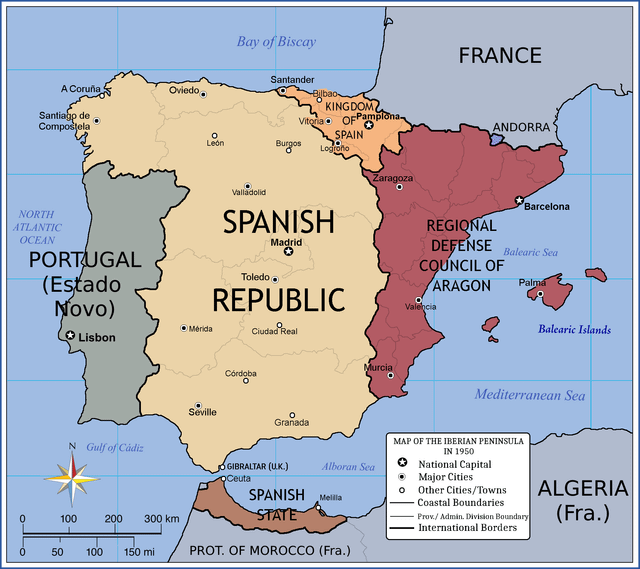
- The Spanish Civil War was fought between the Republicans on the Left and the Nationalists on the Right. The Nationalists controlled parts of northern Spain and areas around Cadiz and Seville, while the Republicans held major cities like Madrid and Barcelona for a long time.
- The Nationalists were supported by the army, monarchists, Church and Falangists, while the Republicans included socialists, communists, anarchists and liberals. Germany and Italy supported Franco with troops, arms and supplies, while the Soviet Union supported the Republicans. Britain and France officially followed a policy of non-intervention.
- The war was extremely destructive. Nearly half a million people died. Barcelona and Catalonia fell in January 1939, and Madrid surrendered in March 1939, ending the war in Franco’s favour.
Reasons for Nationalist Victory
Franco was a skilled military leader and succeeded in uniting the Right. The Republicans, on the other hand, remained divided due to conflicts among socialists, anarchists and communists. External support from Germany and Italy also played a decisive role in Franco’s victory.
Fascism in Spain under Franco
After the Civil War, General Franco became the undisputed leader of Spain. He adopted many Fascist features, though his regime remained strongly connected with traditional Spanish conservatism and the Roman Catholic Church.
Features of Fascism in Spain
- Dictatorship and Repression- Franco took the title Caudillo, similar to Hitler’s Führer and Mussolini’s Il Duce. His regime used military courts, repression, executions and concentration camps to crush opposition.
- One-Party Rule- All right-wing groups were merged under the Falange, and other political parties were banned. This created a single-party authoritarian system.
- Support to the Church - Unlike some other Fascist regimes, Franco strongly supported the Roman Catholic Church, which became the state Church. The Church enjoyed a privileged position in public life.
- Censorship and Cultural Control - Strict censorship was imposed on the media. Critics were punished, and regional identities were suppressed. The use of Catalan, Galician and Basque languages in official documents was banned. Cultural symbols like the Catalan dance Sardana were discouraged as “non-Spanish.”
- Conservative Social Policy - Franco reversed Republican reforms related to women’s rights. Homosexuality and prostitution were criminalised, and traditional family values were promoted.
- Economic Policy and Isolation - Spain remained economically isolated until around 1950. Later, the regime gradually opened up and promoted agriculture and industry.
- Neutrality in World War II- Although Franco was ideologically close to Hitler and Mussolini, he kept Spain out of World War II despite Hitler’s pressure.
- Later Liberalisation - In the 1960s, Franco reduced some repression. Military courts were abolished, and limited parliamentary elections were introduced. After Franco’s death, Juan Carlos became king and supported a return to democracy. Spain held its first free elections in 1977.
Nazism
- Nazism, or National Socialism, was a far-right totalitarian ideology developed by Adolf Hitler’s National Socialist German Workers’ Party in Germany. It emphasised extreme nationalism, racial superiority of the Aryan race, anti-Semitism, one-party dictatorship, militarism and complete control of the State over society.
- Nazism emerged in the 1920s, came to power in 1933, and dominated Germany until the end of World War II in 1945. It rejected liberal democracy, parliamentary government, individual freedom and communism.
- Nazism under Hitler was a totalitarian ideology based on dictatorship, racial supremacy, militarism, anti-Semitism, propaganda and state control.
Features of Nazism
- Political Features- Germany became a one-party state under the Nazi Party. All other parties were banned, state parliaments lost real power, and administration came under Nazi control. The SS and Gestapo created a police state, suppressing opposition through terror, biased courts and concentration camps. Hitler adopted the title Führer and demanded absolute loyalty.
- Social and Educational Features- Education, media and youth organisations were used for Nazi propaganda. Schools promoted Aryan superiority, loyalty to Hitler and hatred against Jews. Boys joined the Hitler Youth, while girls joined the League of German Maidens. Media and religion were also brought under state control.
- Anti-Semitic Policy- Anti-Semitism was central to Nazism. Hitler blamed Jews for Germany’s defeat, Versailles humiliation, unemployment and communism. The Nuremberg Laws, 1935 deprived Jews of citizenship and banned inter-marriage. Later, Nazi persecution led to the Holocaust, aiming at the extermination of Jews.
- Economic Features- Trade unions were abolished and replaced by the German Labour Front. Strikes were banned. The economy followed autarky, aiming at self-sufficiency and war preparation. The Four-Year Plan, 1936 focused on industrial control, agricultural growth, price regulation, rearmament and public works.
- Mass Appeal - Nazism appealed to farmers through price support, workers through jobs and leisure schemes, businessmen through anti-communism and law and order, and the army through rearmament and rejection of the Treaty of Versailles.
Rise of Nazism in Germany
- The rise of Nazism in Germany was closely linked with the political instability, economic crisis and national humiliation that followed the First World War. The defeat of Imperial Germany and the abdication of Kaiser Wilhelm II led to the establishment of the Weimar Republic.
- However, the old power groups—industrialists, big landlords and army officers—remained influential and gradually turned towards anti-democratic forces like Nazism to protect their interests and check the growth of socialism.
- A major reason for Nazi popularity was the resentment created by the Treaty of Versailles. Many Germans considered it unjust and humiliating because it imposed war guilt, heavy reparations and military restrictions on Germany.
- The economic burden of reparations worsened public misery and weakened faith in the Weimar government.
- The situation became worse after the Great Depression of 1929. Germany faced unemployment, industrial decline and social distress.
- The Nazis used this crisis to attack democracy, communism and the Versailles settlement, while promising national revival, employment and strong leadership.
Role of Adolf Hitler
- After World War I, Adolf Hitler moved to Munich and joined a small right-wing political group in 1920. This group later became the National Socialist German Workers’ Party, or the Nazi Party. It opposed the Treaty of Versailles, communism and parliamentary democracy. The party adopted the swastika as its symbol and created a private militia called the Stormtroopers or Brownshirts.
- Hitler soon emerged as the party’s leader because of his powerful oratory, organisational skill and ability to mobilise public anger. Inspired by Mussolini’s March on Rome, Hitler attempted to seize power in Munich through the Beer Hall Putsch of 1923, but failed and was imprisoned.
- During imprisonment, Hitler wrote Mein Kampf, in which he presented his ideas of German nationalism, Aryan racial superiority, anti-Semitism, anti-communism and expansionism. He described Germans as a “master race” and declared Jews, Slavs and Gypsies as inferior.
Nazis’ Rise to Power
- By 1932, the Nazi Party had become the strongest political force in Germany. Conservative leaders believed they could use and control Hitler to defeat communism. As a result, President Paul von Hindenburg appointed Hitler as Chancellor in January 1933. Thus, Hitler came to power legally, but soon destroyed democracy from within.
- After becoming Chancellor, Hitler established a totalitarian regime. Opposition parties were banned, political opponents were arrested, and the SS and Gestapo were used to spread terror. In 1934, hundreds of Hitler’s opponents were killed, forcing most Germans into silence and obedience.
Anti-Semitism and Persecution of Jews
- Anti-Semitism was central to Nazi ideology. Although Jews formed less than one percent of Germany’s population, Hitler blamed them for Germany’s defeat, the Versailles humiliation, economic crisis, unemployment and communism.
- From 1933 onwards, the Nazis passed laws that deprived Jews of their rights. Violence against Jews increased, reaching a major stage on 9 November 1938, known as Kristallnacht, when Jewish homes, shops and synagogues were attacked and destroyed.
- World War II and End of Hitler - In 1939, Hitler attacked Poland, which triggered the Second World War. For some years, Germany achieved major military victories, but later suffered defeats. As Germany’s defeat became certain in 1945, Hitler committed suicide in his bunker, marking the end of Nazi rule.
Similarities between Nazism and Fascism
- Supremacy of the State- Both Nazism and Fascism believed in the absolute supremacy of the State. Fascism promoted the idea that nothing should exist against or above the State, while Nazism also expected every individual to merge his identity with the State.
- Opposition to Democracy- Both ideologies rejected democracy because they considered it weak, slow and divisive. They favoured centralised authority, dictatorship and strict discipline instead of decentralisation and political pluralism.
- Supremacy of the Leader- Both systems glorified the leader. Mussolini in Italy and Hitler in Germany were projected as supreme leaders whose authority could not be questioned. Absolute obedience to the leader was a core feature of both regimes.
- No Individual Liberty- Nazism and Fascism gave little importance to individual freedom. Fascism treated liberty as a duty towards the State, not as a right against the State. Nazism also subordinated the individual completely to the collective will of the nation and State.
- Racial and National Superiority- Both ideologies promoted ideas of racial or national superiority. They believed that their nation or race was superior and had the right to dominate weaker or “inferior” peoples.
- One-Party Rule- Both Italy and Germany became one-party states. The Fascist Party in Italy and the Nazi Party in Germany eliminated political rivals and argued that multiple parties weakened national unity.
- Anti-Communism - Both Nazism and Fascism were strongly anti-communist. They opposed socialism, class struggle and communist movements, which helped them gain support from industrialists, landlords and conservative classes.
Differences between Nazism and Fascism
Although Nazism and Fascism shared many common features such as dictatorship, nationalism, one-party rule and anti-communism, they also differed in several important ways.
|
Basis |
Nazism |
Fascism |
|
Meaning |
German form of Fascism led by Adolf Hitler. |
Italian authoritarian ideology led by Benito Mussolini. |
|
Core Ideology |
Based mainly on racial superiority, Aryanism and anti-Semitism. |
Based mainly on state supremacy, nationalism and authoritarian rule. |
|
Race |
Race was central; Germans were projected as the master race. |
Race was not originally central; it became important later under Nazi influence. |
|
Anti-Semitism |
Strong anti-Jewish policy; led to the Holocaust. |
Initially not strongly anti-Jewish; adopted racial laws later due to German influence. |
|
Doctrine |
Promoted “Blood and Soil”, linking race, land and peasantry. |
No such doctrine; focused more on the glory of the State and Roman past. |
|
Religion |
Often came into conflict with the Church and tried to control religion. |
Made compromise with the Church through the Lateran Treaty, 1929. |
|
Leader’s Position |
Hitler became both Head of State and Head of Government. |
Mussolini was mainly Head of Government and theoretically under the King. |
|
Economic Policy |
State-directed economy focused on rearmament, autarky and war preparation. |
Supported capitalism under state supervision and created a corporate state. |
|
Degree of Brutality |
More fanatical, racial and brutal. |
Authoritarian and militaristic, but less racial in its original form. |
|
Final Outcome |
Led Germany towards World War II and genocide. |
Led Italy towards dictatorship, militarism and alliance with Nazi Germany. |


.svg.png)


