
Constitutional Bodies
Constitutional Bodies
A Constitutional Body in India is an institution established or mandated by the Constitution. Its composition, powers, functions and duties are defined explicitly in the Constitution. These bodies play a key role in upholding democratic governance and ensuring the effective implementation of constitutional provisions.
Election Commission of India (ECI)
Constitutional Provision: Established under Article 324 of the Constitution of India.
Composition:
- Consists of a Chief Election Commissioner (CEC) and such number of Election Commissioners as determined by the President of India.
- Current Composition: 1 CEC + 2 Election Commissioners.
Appointment:
- Appointed by the President of India based on recommendations from a three-member Selection Committee:
- The Prime Minister of India
- A Union Minister nominated by the PM
- The Leader of Opposition in the Lok Sabha
Tenure: Chief Election Commissioner and the Election Commissioners hold office 6 years or until the age of 65, whichever is earlier.
Removal:
- Chief Election Commissioner: Removed in the same manner as a Supreme Court judge.
- Other Election Commissioners: Can be removed based on the CEC’s recommendation.
Resignation: Can resign by submitting a written notice to the President.
Post-Tenure Appointments: Eligible for further appointments by the Union Government.
Powers and Functions:
- Responsible for the superintendence, direction, and control of elections to:
- Parliament
- State Legislatures
- Offices of the President and Vice-President of India
- Administrative Functions
- Determine constituency boundaries under the Delimitation Commission Act.
- Prepare and update electoral rolls; register eligible voters.
- Notify election schedules and scrutinize nominations.
- Recognize political parties and allocate election symbols.
- Enforce the Model Code of Conduct (MCC).
- Schedule party publicity on radio and TV.
- Cancel elections in cases of rigging or malpractice.
- Request President/Governor support for election staff.
- Supervise election machinery nationwide for free and fair polls.
- Classify parties as national or state parties based on election performance.
- Advisory Functions
- Advise President on disqualification of Parliament members.
- Advise Governor on disqualification of State Legislature members.
- Recommend whether elections can be held during President’s Rule in a state.
- Quasi-Judicial Functions
- Settle disputes regarding party recognition and symbol allocation.
Appoint officers to inquire into electoral disputes.
Union Public Service Commission (UPSC) and State Public Service Commission (SPSC):
|
Feature |
Union Public Service Commission (UPSC) |
State Public Service Commission (SPSC) |
|
Constitutional Provision |
Articles 315–323,Part-XIV |
Articles 315–323, Part-XIV |
|
Composition |
Chairman + members as determined by President of India |
Chairman + members as determined by Governor of the State |
|
Appointment Authority |
President of India |
Governor of the State |
|
Tenure |
6 years or until 65 years |
6 years or until 62 years |
|
Removal |
By President on constitutional grounds; for misbehaviour, Supreme Court enquiry required |
By President on constitutional grounds; Supreme Court enquiry required; though appointed by Governor, removal is only by President |
|
Resignation |
By writing to President |
By writing to Governor |
|
Post-Tenure Appointment |
Chairman: Not eligible for further employment; Members: can become Chairman of UPSC or SPSC, but not other employment |
Chairman: can become Chairman/member of UPSC or SPSC, but not other employment; Members: can become Chairman/member of UPSC or any SPSC, but not other employment |
|
Reappointment |
Neither Chairman nor Members are eligible for a second term |
Neither Chairman nor Members are eligible for a second term |
|
Powers and Functions |
Central recruiting agency for All India Services, Group A and Group B posts, Parliament, State Legislatures, President & Vice-President offices |
Conducts state-level exams and appointments for State Services |
Joint State Public Service Commission (JPSC)
- Constitutional Provision: Article 315(2) of the Constitution.
- Creation: Established by Parliament by law for two or more states.
- Appointment: Members and Chairman are appointed by the President of India.
- Tenure:6 years or until the age of 62 years, whichever is earlier.
- Removal: Can be removed by the President of India on constitutional grounds.
- Resignation: Members or Chairman may resign by submitting a written notice to the President.
- Reporting: Reports are submitted to the Governor of each participating state, who then presents it to the respective State Legislature.
- Function: Conducts examinations and recruitment for state services across the participating states, similar to a State Public Service Commission but shared between multiple states.
Finance Commission of India (FCI)
|
Feature |
Details |
|
Constitutional Provision |
Article 280 |
|
Composition |
- Chairman: Person with experience in public affairs- 4 Members: Selected from among: High Court judge or qualified to be appointed as one, expert in government finance/accounts, experienced administrator in financial matters, person with special knowledge of economics |
|
Qualifications |
Chairman: Experience in public affairs; Members: High Court judge/finance/account expert/administrator/economist |
|
Appointment |
By the President of India |
|
Tenure |
As specified by the President’s order, Members are eligible for reappointment. |
|
Functions |
- Recommend distribution of net proceeds of taxes between Centre and States- Suggest principles for grants-in-aid to States from Consolidated Fund of India- Recommend measures to augment State Consolidated Fund to support Panchayats and Municipalities, based on State Finance Commission- Advise on any other matter referred by the President for sound finance |
|
Reporting |
- Submit report to the President- President lays the report before both Houses of Parliament with an explanatory memorandum on actions taken |
Goods and Services Tax (GST) Council:
|
Feature |
Details |
|
About |
The Goods and Services Tax (GST) Council is a constitutional body in India, responsible for policy-making, rules, and recommendations on GST for the Union and State Governments. Its Secretariat is located in New Delhi. |
|
Constitutional Provision |
The 101st Constitutional Amendment Act, 2016 inserted Article 279-A, empowering the President to constitute the Goods and Services Tax (GST) Council. Accordingly, the President issued the order in 2016 to establish the GST Council. |
|
Composition |
|
|
Ex-Officio Secretary |
Union Revenue Secretary |
|
Working of the GST Council |
|
|
Functions |
- Recommend taxes, cesses, and surcharges to be merged into GST |
National Commission for Backward Classes (NCBC)
|
Feature |
Details |
|
About |
Origin: Evolved following the Mandal Case (Indira Sawhney vs. Union of India, 1992). Supreme Court Direction (1992): Central government to set up a permanent body to address complaints of non-inclusion, under-inclusion, or over-inclusion of any backward class in the official lists. Establishment as Statutory Body (1993): Parliament enacted the National Commission for Backward Classes Act, 1993, under the Ministry of Social Justice and Empowerment. |
|
Constitutional Provision |
Article 338B of the Constitution of India. |
|
Purpose |
Safeguard the social, educational, economic, and cultural interests of SEBCs; monitor safeguards, address deprivation complaints, and advise on development |
|
Composition |
Chairperson, Vice-Chairperson, 3 Members |
|
Appointment |
By President of India |
|
Tenure |
3 years; not eligible for more than two terms |
|
Resignation |
By writing to the President |
|
Powers |
- Investigate matters related to SEBC safeguards |
|
Reporting |
Reports presented to President, placed before Parliament; State-related reports sent to Governor, then to State Legislature |
|
Key Functions |
- Monitor implementation of safeguards |
|
Latest Update 105th Amendment Act, 2021: States exempted from mandatory consultation on their own SEBC lists |
|
National Commission for Scheduled Castes (NCSC):
|
Feature |
Details |
|
Establishment |
|
|
Constitutional Provision |
Article 338 (Part XVI) |
|
Composition |
Chairperson, Vice-Chairperson, 3 Members |
|
Appointment |
By President of India by warrant under hand and seal |
|
Tenure |
3 years; members not eligible for more than two terms |
|
Functions |
- Investigate and monitor constitutional and legal safeguards for SCs |
|
Special Notes |
- Functions also cover Anglo-Indian Community |
|
Powers |
- Regulate own procedure |
|
NCSC Reporting |
|
National Commission for Scheduled Tribes (NCST):
|
Feature |
Details |
|
About |
Constitutional Provision: Article 338-A of the Indian Constitution. Provides safeguards against exploitation. Headquarters: New Delhi. |
|
Composition |
Chairperson, Vice-Chairperson, 3 Members appointed by the President of India |
|
Tenure |
3 years; members not eligible for more than two terms |
|
Functions |
- Monitor and evaluate constitutional and legal safeguards for STs |
|
Powers |
Regulates its own procedure. Has civil court powers while investigating or inquiring, including:
Can act on any matter referred by the President. Central and State Governments must consult NCST on all major policy matters affecting Scheduled Tribes. |
|
NCST Reporting |
|
Comptroller and Auditor General of India (CAG)
Constitutional Status:
- Constitutional authority under Articles 148–151 of the Constitution.
- Independent auditor of Central Government, State Governments, and bodies funded by them.
- Acts as the Guardian of the Public Purse.
Composition & Appointment:
- First CAG: V. Narhari Rao; Current: Shri K. Sanjay Murthy.
- Appointed by the President of India.
- Tenure: 6 years or until 65 years of age, whichever is earlier.
- Can serve as External Auditor for international bodies like WHO, FAO, ILO, IAEA.
Functions:
- Audits receipts and expenditures from the Consolidated Fund of India, State Funds, UTs with Legislative Assemblies, Contingency Funds, and Public Accounts.
- Audits government companies, corporations, and bodies receiving grants/loans from government.
- Ensures effective check on revenue collection, allocation, and government spending.
- Guides the Public Accounts Committee (PAC) in Parliament.
- Advises the President on the form of accounts for Union and States (Article 150).
- Submits audit reports to the President (Union) and Governors (States) for presentation before legislatures (Article 151).
- Certifies net proceeds of taxes and duties (Article 279) — certificate is final.
Powers:
- Powers of a civil court while auditing:
- Inspect any office/department under audit.
- Examine transactions and question responsible officials.
- Call for records, papers, and documents.
- Decide scope and manner of audits.
Reports of the Comptroller and Auditor General of India (CAG)
- Audit Report on Appropriation Accounts: Compares actual expenditure with Parliament-approved expenditure under the Appropriation Act.
- Audit Report on Finance Accounts: Shows annual receipts and disbursements of the Union Government.
- Audit Report on Public Undertakings: Examines accounts of government-owned companies and undertakings.
- Presentation: All reports are submitted to the President, who lays them before both Houses of Parliament.
- Parliamentary Review: The Public Accounts Committee (PAC) examines these reports and presents its findings to Parliament
Attorney General of India (AGI) and Advocate General of India (AG):
|
Feature |
Attorney General of India (AGI) |
Advocate General of State (AG) |
|
Constitutional Article |
Article 76, Part V |
Article 165, Part VI |
|
Appointed By |
President of India |
Governor of the State |
|
Qualification |
Qualified to be Supreme Court judge; must have been a judge of High Court for 5+ years or an advocate of High Court for 10+ years, or eminent jurist in President’s opinion |
Qualified to be High Court judge; must have been a judge of High Court for 10+ years or an advocate for 10+ years, or eminent jurist in President’s opinion |
|
Tenure |
Not fixed by Constitution; holds office during pleasure of President; conventionally till Council of Ministers has confidence in Parliament |
Not fixed by Constitution; holds office during pleasure of Governor; conventionally till Council of Ministers has confidence in State Legislature |
|
Salary |
Determined by President |
Determined by Governor |
|
Resignation |
To President |
To Governor |
|
Removal Procedure |
Constitution does not specify; office held at President’s pleasure |
Constitution does not specify; office held at Governor’s pleasure |
|
Miscellaneous / Powers |
- Highest law officer in the country- Not a full-time counsel; can practice privately- Right of audience in all courts in India- Right to speak and take part in Parliament proceedings, without vote- Enjoys privileges & immunities of a Member of Parliament |
- Highest law officer of the State- Right of audience in state courts- Right to speak and participate in State Legislature proceedings, without vote- Enjoys privileges & immunities of a Member of State Legislature |
Commissioner for Linguistic Minorities (CLM)
- Constitutional Provision: Article 350-B
- Established By: 7th Constitutional Amendment Act, 1956
- Composition: Single-member body (Commissioner for Linguistic Minorities)
- Appointment: By the President of India
- Headquarters: New Delhi
- Regional Offices: Belgaum (Karnataka), Chennai (Tamil Nadu), Kolkata (West Bengal)
- Ministry: Ministry of Minority Affairs
- Functions:
- Investigate matters related to constitutional and statutory safeguards for linguistic minorities.
- Submit annual or special reports on implementation status to the President of India.
- Monitor safeguards through questionnaires, field visits, conferences, seminars, meetings, and review mechanisms.
Finance Commission
|
Aspect |
Details |
|
Meaning and Nature |
The Finance Commission is a constitutional body established under Article 280 of the Indian Constitution. It is constituted by the President every five years or earlier, if required, to recommend the distribution of financial resources between the Union and the States. |
|
Purpose |
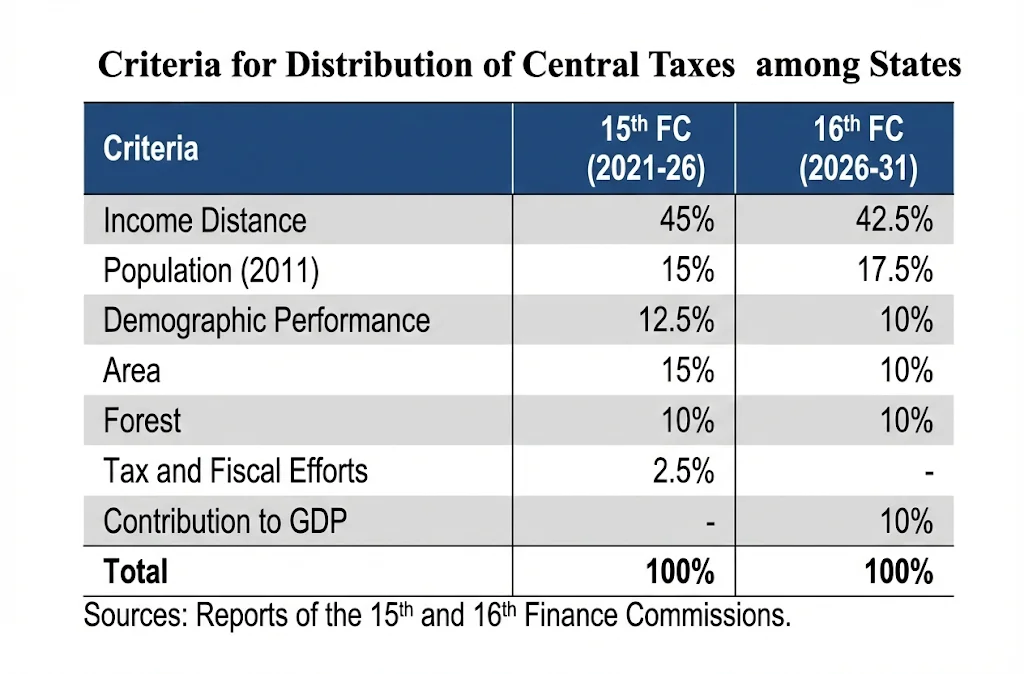
Its main purpose is to strengthen fiscal federalism by ensuring a fair, balanced and predictable sharing of revenue. It addresses both the vertical imbalance between the Centre and States and the horizontal imbalance among States with different financial capacities and developmental needs. |
|
Composition and Appointment |
The Commission consists of a Chairman and four other members, appointed by the President of India. Parliament determines the qualifications of the members and the manner of their selection. Generally, members are persons with experience in public affairs, finance, economics, administration or law. |
|
Tenure |
Members hold office for the period specified by the President. A new Finance Commission is normally constituted every five years, making it a periodic but highly important constitutional institution. |
|
Major Functions |
The Finance Commission recommends the distribution of net proceeds of taxes between the Centre and States, allocation of States’ share among different States, principles governing grants-in-aid, and measures to strengthen the finances of Panchayats and Municipalities on the basis of State Finance Commission recommendations. |
|
Grants-in-Aid Role |
It recommends grants from the Consolidated Fund of India to States that require financial support for revenue gaps, special needs or specific developmental purposes. |
|
Nature of Recommendations |
Its recommendations are advisory, but they carry great constitutional, financial and political importance and are generally accepted by the Union Government. |
|
Importance |
The Finance Commission promotes cooperative federalism, supports weaker States, ensures predictable transfers, reduces regional inequality, strengthens local bodies and helps maintain fiscal stability in the Indian Union. |
|
Challenges / Issues |
Major issues include the growing use of cesses and surcharges outside the divisible pool, tension between equity and performance-based incentives, rising fiscal dependence of States on central transfers and the non-binding nature of its recommendations. |
|
Miscellaneous |
The Finance Commission acts as a neutral constitutional mechanism for financial adjustment between different levels of government. It plays a central role in balancing national priorities with State-level development needs and remains one of the most important institutions of India’s fiscal federal structure. |


.svg.png)


